
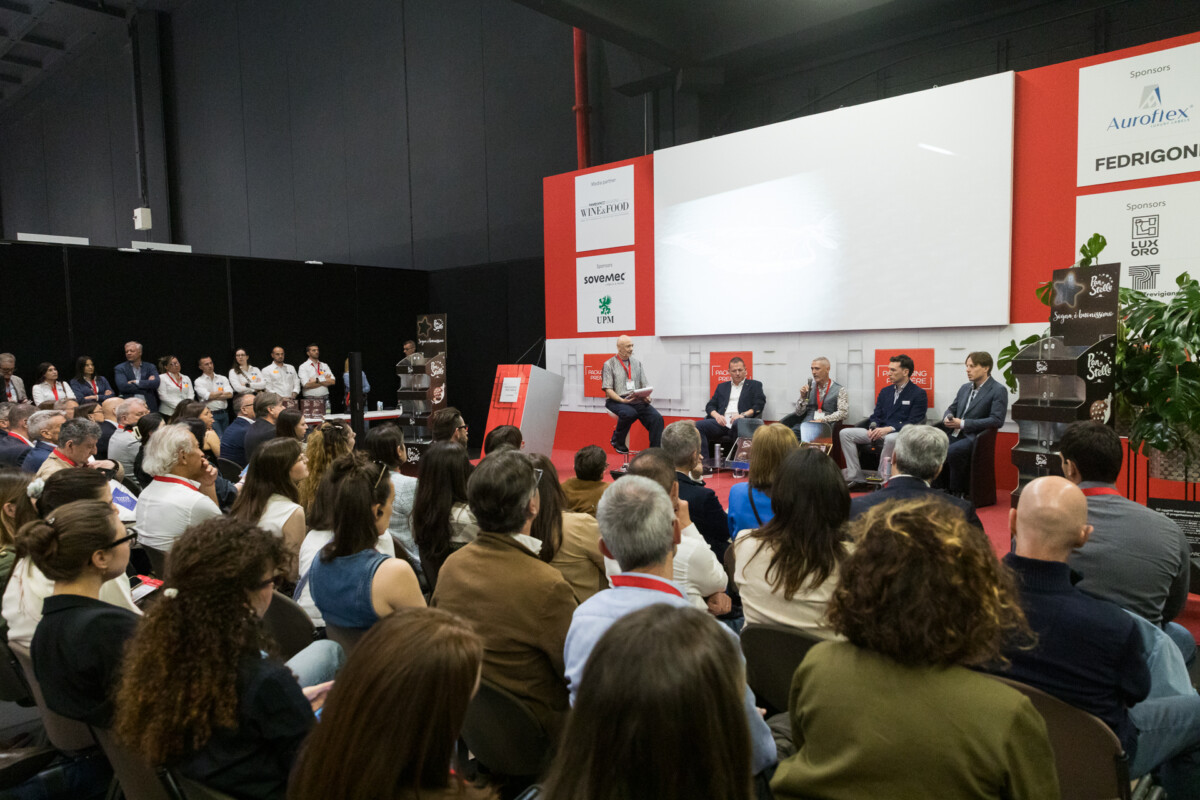
In food packaging for large-scale retail, metallisation has long been associated with plastic laminates that are difficult to recycle. The project presented at Packaging Première by Barilla, Luxoro-Kurz, Plastigraf Trevigiana and Fedrigoni aims to address this issue at its source, using a technology that transfers metallic effects onto pure paper, eliminating plastic from the final product – supported by LCA (Life Cycle Assessment) data.
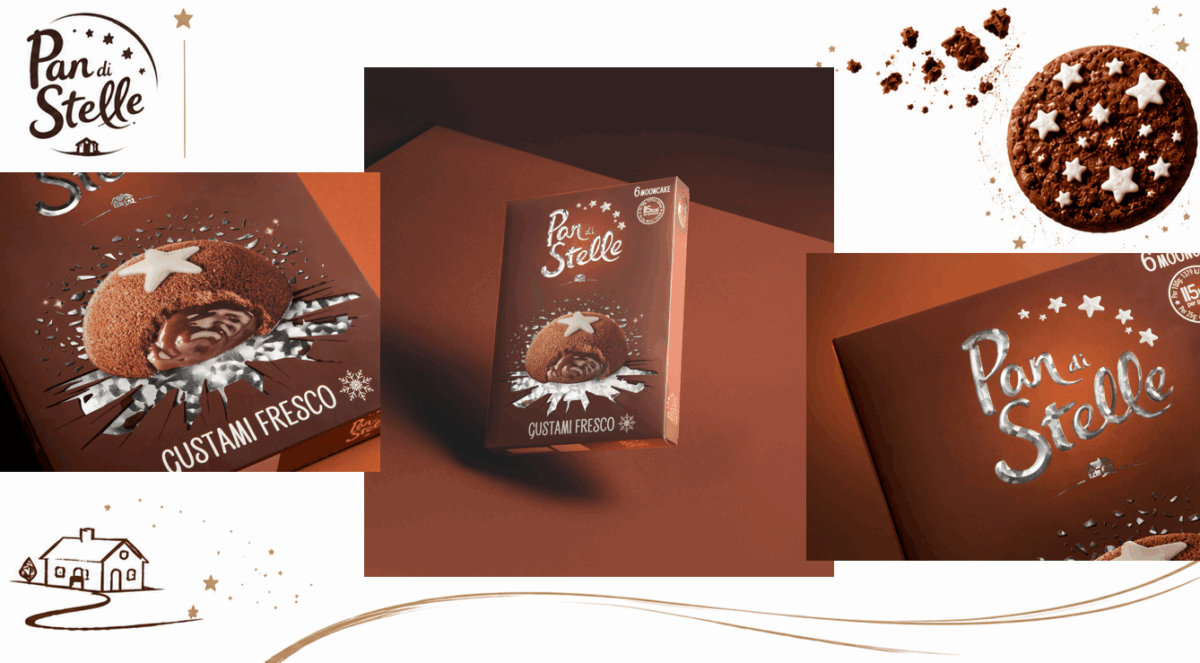
The packaging developed for Mooncake Pan di Stelle uses the KTM (Kurz Transfer Metal) system in its Gem variant, selected to evoke a sense of ice and freshness consistent with the product’s claim “gustami fresco” (“enjoy me fresh”). The process involves laminating the entire paper substrate with the KTM film, onto which offset printing is then applied in the graphic areas defined by Barilla. In a third step, as explained by Alessandro Carnevale, Brand Ambassador & Sustainability Manager at Luxoro, the Pan di Stelle logo and the Mooncake imagery undergo a two-level hot stamping embossing: a first polishing effect followed by an additional hot foil layer that enhances the star details. The final visual result is highly layered and impactful, yet the material reaching the shelf is paper. The polyester film – used as a mechanical carrier for the transfer of the decorative finish – is removed during the industrial delamination phase, before the packaging enters the distribution chain. The recovered polyester is then reintroduced into production through Kurz’s Recosys recycling system.
Alessandro Capoferri, CEO of Plastigraf Trevigiana, outlined the main critical challenges in bringing this technology to an industrial standard. The first obstacle was mechanical resistance: one of plastic’s key advantages is its ability to withstand creasing and the KTM system required extensive fine-tuning to achieve equivalent performance. The second challenge was scratch resistance – particularly crucial for displays, which are subject to continuous handling and stress at the point of sale. According to Capoferri, the final result now surpasses the characteristics of traditional plastic packaging, offering better abrasion resistance, higher gloss and a weight reduction of 20-25 grams compared to an equivalent PET-based solution.
Fedrigoni conducted a comparative Life Cycle Assessment between the KTM solution and the previous technology, which relied on full metallisation on a plastic laminate. The results showed a 10% reduction in CO₂ emissions. Eugenio Brunori, Sustainability Manager at Fedrigoni, was keen to put this figure into context. The metallic film accounts for only a small proportion of the packaging’s overall mass balance, with paper remaining the dominant component. Against this background, a 10% reduction represents a significant achievement. Fedrigoni’s approach to the project was explicitly positioned against greenwashing: no environmental claims without certified measurements to support them. This reflects the company’s commitment to anticipating forthcoming European regulations, which will require environmental claims to be backed by verifiable evidence.
Massimiliano Ferrari, Graphic Packaging Center of Expertise at Barilla, positioned the project within the premiumisation strategy that the CoE has been developing over the past few years. The approach has also been extended to other brands within the Barilla Group through the use of tactile coatings, textured finishes and decorative effects designed to reflect the character of each product. The context is that of large-scale retail, where purchasing decisions are made in a matter of seconds and the supermarket shelf is, in Ferrari’s words, “a battlefield.” The challenge was not to reinvent the identity of Pan di Stelle, but to enhance its perceived value without compromising its recognizability – a packaging solution that is disruptive enough to capture the consumer’s attention at the crucial moment of choice.
In their closing remarks, all the speakers emphasised one key point: scalability. This is not a demonstration project or a concept developed solely for exhibition purposes – the process is already commercially available. Carnevale stated this explicitly, describing the technology as “ready to use, replicable tomorrow.” He also stressed that early collaboration between brand owners, converters and technology providers is essential to making projects like this economically viable. In this case, sustainability extends beyond environmental performance. It must also be technological, aesthetic and commercially viable. If any one of these three pillars fails, the project itself cannot succeed.
Lorem ipsum dolor sit amet, consectetur adipiscing elit Lorem ipsum dolor sit amet, consectetur adipiscing elit


