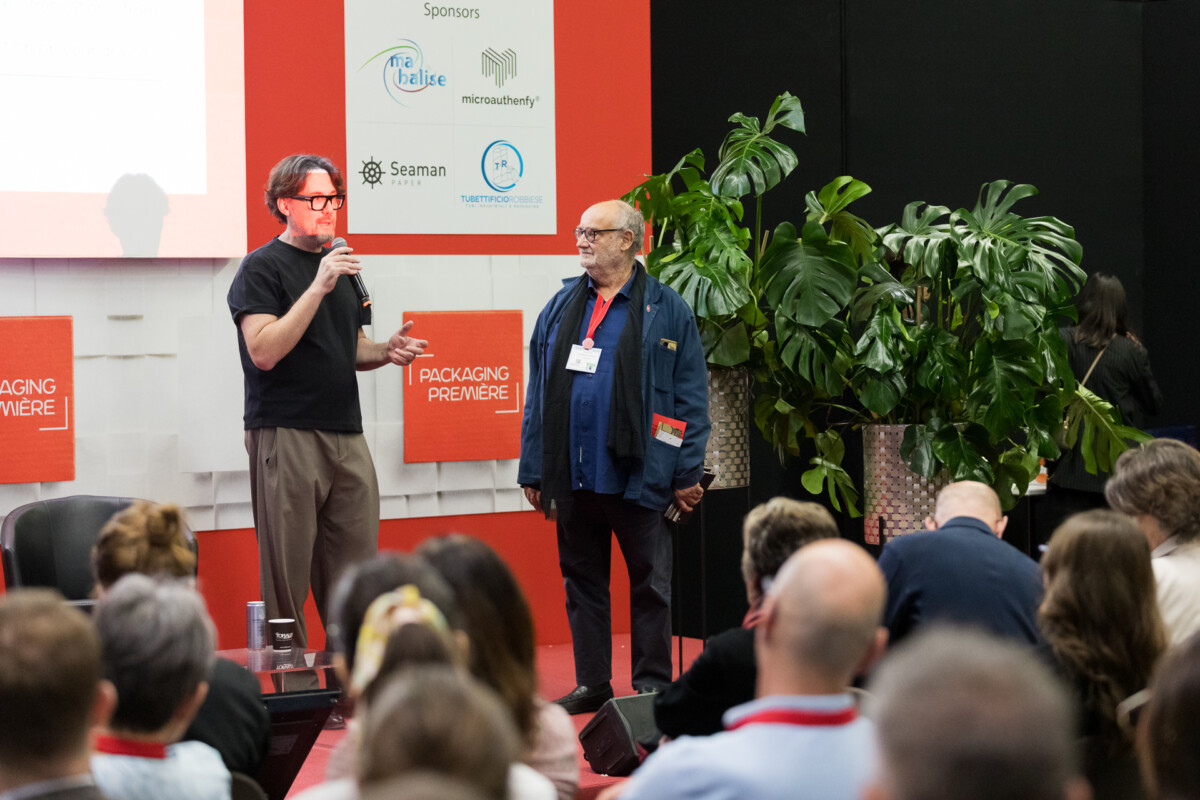
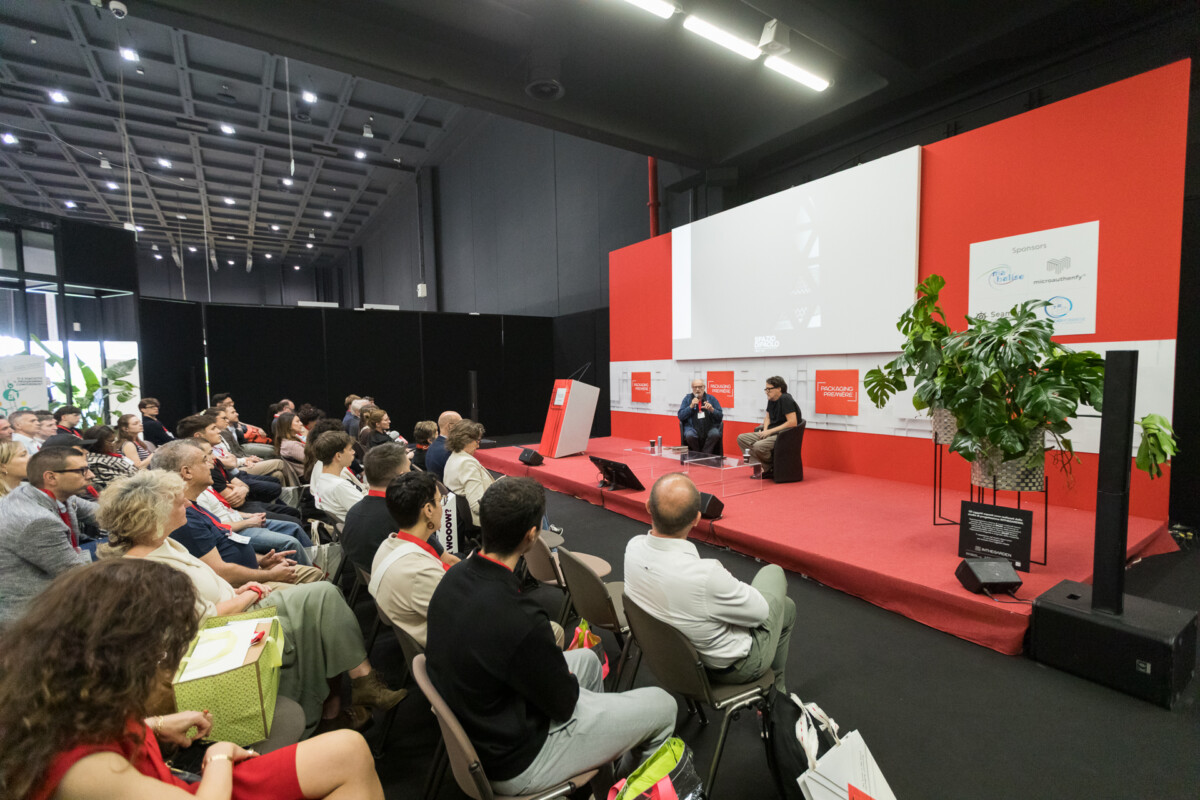
Mario Di Paolo, founder of Spazio Di Paolo, and Luca Fois, lecturer at Politecnico di Milano, brought to the Packaging Première stage a conversation among friends – almost “within a family” – in front of an audience that in fact represents that very family every day: designers, manufacturers, brands, and suppliers. It is a packaging community that comes together to openly reflect on what truly holds the sector together. What does originality really mean? And, more importantly, how is it built, and why is it so difficult to protect it?
You don’t wake up original
The starting point of the dialogue was almost provocative: Di Paolo does not wake up in the morning wondering how to be original. As Fois explained, originality is the result of a method built on research, experimentation and a constant drive toward something always just out of reach. Much like, for Sacchi, scoring goals was not the objective but the consequence of a well-functioning team, originality in a project emerges when the process has been fully and honestly explored. It is not a stylistic choice, but a necessity that surfaces. And perfection, Di Paolo added, is not something to be achieved, it is something to be pursued. The day you reach it is the day you lose the space to keep searching.
The risk of standardization
The true opposite of originality is not ugliness, but unrecognisability. Industry, by its very nature, tends towards scalability – and scalability, in turn, leads to replication. The result is a supply chain that produces correctly, but without identity: a recurring issue observed by Di Paolo each year in his role as artistic director of the Vinitaly Design Award, where formally impeccable projects often lack soul. The answer is not to step outside the industrial framework, but to learn how to inhabit it differently – with method and courage. As he noted, changing perspective is often the most powerful tool available.
Educating, not just producing
The most generous part of the dialogue focused on transmission. Di Paolo is building an Academy in response to an urgent question: how can a method be taught, rather than a style?
The risk he fears is not competition, but unconscious imitation – those who replicate outcomes without understanding the process behind them. Fois described this approach as “maieutic”: someone who helps bring out the identity of others, rather than imposing their own. And perhaps this represents the highest form of belonging to a professional community – not to guard what one knows, but to make it circulate.