
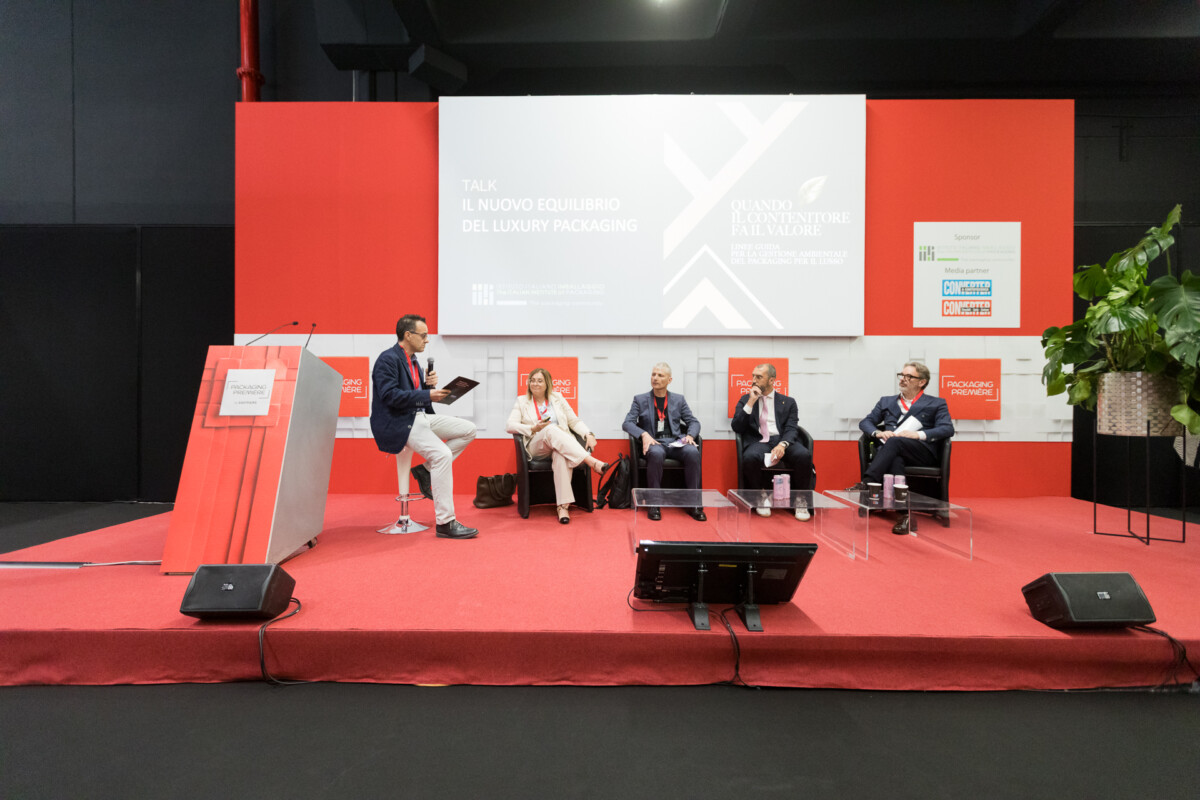
The global luxury packaging market is now worth €17.2 billion, with Italy accounting for around 8% of the sector, equivalent to €1.4 billion and growing at a faster pace than the packaging industry as a whole. Yet the sector is now facing a question that can no longer be postponed: how can it comply with the new European regulation on packaging (PPWR) without sacrificing the very elements that define luxury – weight, materials, finishes and the sensory experience – without which a product simply ceases to be perceived as premium? This was the central theme of the guidelines developed by the Luxury Packaging Commission of the Italian Institute of Packaging, presented at Packaging Première Milan 2026.
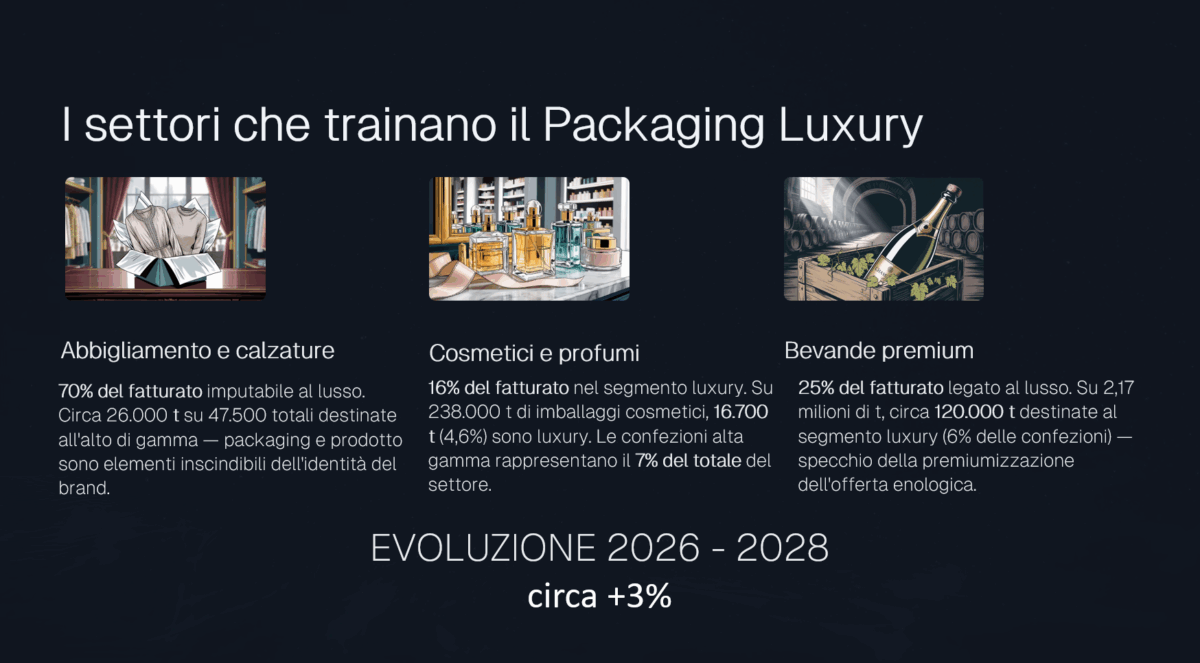
The figures presented by Barbara Iascone, Head of Research at the Italian Institute of Packaging, confirm the sector’s economic importance. Of the 17.6 million tons of packaging produced in Italy in 2025, nearly 209,000 tons are destined for the luxury segment – just over 1% of total volume yet representing a disproportionately higher economic value. Demand is driven primarily by the fashion industry, where 70% of the sector’s turnover in Italy comes from high-end products, followed by cosmetics and perfumery (16%) and premium beverages (25%). From a materials perspective, luxury packaging is distinguished by heavier glass, high-grammage paper and board and the extensive use of textiles and specialty metals that are rarely found in conventional packaging. These characteristics now come into direct conflict with the PPWR’s objectives of reducing packaging weight and optimising material use.
The guidelines, coordinated by Marco Scatto, Coordinator of the Luxury Packaging Commission, are built around a set of interconnected principles: sustainability as a new expression of excellence rather than a compromise; design and technological innovation; full compliance with the PPWR requirements, from design for recycling to the use of recycled and bio-based materials; structured collaboration across the entire value chain; and the integration of circular economy principles from the earliest design stages, rather than as an afterthought. Developed with contributions from brand owners, converters, raw material suppliers and technology providers, the document goes beyond interpreting the regulation. It proposes a multi-stakeholder working methodology based on the diversity of participants, the recognition of different interests, the interdependence of the value chain and continuous collaboration throughout every stage of the project.
From a brand perspective, Luca Amato, Head of Packaging Innovation and Quality at Dolce&Gabbana Beauty, began with an important distinction: speaking of packaging for luxury, rather than luxury packaging, acknowledges that packaging is not a separate element from the product, but an integral part of the experience through which consumers engage with the brand. Weight, materials, finishes and tactile sensations all contribute directly to the perception of quality. According to Amato, this is precisely where the industry’s greatest challenge lies: many of these defining characteristics are now in tension with the PPWR’s objectives of reducing packaging weight and optimising material use. The companies that succeed are those capable of preserving perceived value while embracing sustainability rather than resisting it. Amato also broadened the discussion to include corporate reputation, now one of the luxury industry’s most valuable assets. Engaging stakeholders is no longer limited to consumers – it also involves employees, investors and suppliers, in a context where ESG expectations are increasingly influencing business competitiveness. For this reason, he argued, the entire supply chain must work towards shared standards and common objectives. Events that bring together brands, suppliers, converters and material manufacturers are therefore becoming an increasingly important part of the innovation process.
According to Roberto Della Rupe, Founder and CEO of Luce, the most profound transformation concerns the relationship between brands and suppliers. The shared responsibility introduced by the new regulations makes the traditional client–supplier model no longer sufficient, driving the industry towards genuine industrial partnerships in which converters must understand the regulatory framework just as thoroughly as the technical specifications. Over the past decade, he observed, the sector has undergone a greater transformation than it had in the previous forty years, overcoming the long-held belief that sustainability and perceived quality were inherently incompatible. The speakers concluded with a shared message: in the years ahead, innovation and end-of-life management will become the industry’s key priorities. Rather than viewing regulation as a constraint to be endured, the luxury packaging sector has an opportunity to redefine what excellence truly means.
Lorem ipsum dolor sit amet, consectetur adipiscing elit Lorem ipsum dolor sit amet, consectetur adipiscing elit


